Monday, January 25, 2021

Monday/Tuesday, January 24th/25th AND Thursday/Friday, January 28th/29th

Virtual class directions for (Group B) are located in Schoology folder. 

In-Person Class: 

Monday, January 24th and Thursday, January 25th

1.  Second semester expectations. 

2. Start to Modernism.  Think about what is revealed about the idea of Modernism through this quote by T.S. Elitot. 

 “The term modernism refers to the radical shift in aesthetic and cultural sensibilities evident in the art and

literature of the post-World War One period. The ordered, stable and inherently meaningful world view of

the nineteenth century could not, wrote T.S. Eliot, accord with ‘the immense panorama of futility and

anarchy which is contemporary history.’.. rejecting nineteenth-century optimism, [modernists] presented a

profoundly pessimistic picture of a culture in disarray.”

3. Considering the general idea of Modernism, the TPCASTT method, do a close reading of T.S. Eliot's "The Love Song of J. Alfred Prufrock." DO YOUR BEST.  We are using this as an introductory activity to a philosophical shift in thought that will frame this unit. Think about what you are learning about Modernism from this poem.  You will turn in your annotated copy to Schoology. 

Epigraph translation: 

The poem begins with: A passage from Dante Alighieri’s Inferno (Canto 27, lines 61-66) spoken by Guido da Montefeltro in response to the questions of Dante, who Guido supposes is dead, since he is in Hell. The quotation comes from Dante’s exploration of the eighth circle of Hell, where he meets a man named Guido who is condemned for the rest of his life, and doesn’t even have his own body anymore, he is just a flame (“this flame would shake no more.”) Guido refuses to tell Dante why he has been sent to such a deep level of Hell as he has never met someone who can leave the place and fears people on earth with find out what he did. He is afraid that his reputation will be ruined. However, since he believes it is impossible for Dante to leave, he tells him of his sins anyway, but of course Dante does return from Hell.

 This selection hints that the poem is about bad people masking themselves to be good because the clip is about a man, Guido, in Hell talking to Dante. It is about the importance of his reputation and how he does not want people on Earth to know what he did to end up in Hell. Guido believes that Dante will not be able to tell people on Earth about his sins, but unfortunately this is not the case. J. Alfred Prufrock may be worried about his reputation as well as Guido and therefore confess’ his “love song” to the audience who will not be able to share it with other people. The poem is a confession, just as Guido confesses his sins to Dante.

The flame in which Guido is encased vibrates as he speaks:

   “If I thought that I was replying to someone who would ever return to the world,
    this flame would cease to flicker. But since no one ever returns from these depths alive, 
    if what I’ve heard is true, I will answer you without fear of infamy.”

Tuesday, January 25th and Friday, January 29th

4. After your initial close reading is done, we will gather in small groups to work through this poem. Discuss the poem, using the poetry guide. Complete the guide. You will individually turn this guide in to Schoology. DUE for class on Tuesday/Friday. We will work with this poem in class. Upload these questions by Friday, January 29th. 

5. Utilizing the database, JSTOR, you will research and find a secondary article/essay addressing Eliot's "Prufrock." Download the essay. Read and annotate. Upload the annotated copy to Schoology. Post in comments the following: 1. The author's claim. 2. The correct MLA citation for the essay. Upload by Friday, January 29th 

LSW LMC Research Page

Purdue OWL- Citing Electronic Sources

Watch the following videos for RESEARCH TIPS: 

Online Research Tips

Developing Keywords for Research

Quick Tips and Shortcuts Databases


Tuesday, January 19, 2021

Week of January 19th-21st

You have made it! The last week of semester 1! 

It is an interesting week bringing a close to a challenging semester. Therefore, as we are gearing up for a return to hybrid next week, I am letting you work at your own speed this week. I am sure there is a lot going on this week, with the semester end, so you have time to get things wrapped up. 

Therefore, we will NOT have a live class meeting this week. Open the folder for this week on Tuesday, and work at your own speed this week.  The two assignments are due by the end of the day on Friday. 

If you need ANY HELP! I am available for one-on-one meetings all this week! 

___________________________________________________

It is also Inauguration Week. We have been studying argument in conjunction with President Kennedy's 1961's Inaugural Address. 

We have examined how these addresses function as an analysis of the country's situation and an argument as to the plan for the upcoming four years. 

Therefore, for this week please complete the following: 

1. Watch Michael Beschloss, American Historian, discuss what makes an effective inaugural address. (Schoology folder)

2. Open up and make two copies of the inaugural address rubric. (Schoology folder)

3. Assignment #1: select one of the linked addresses of inaugural addresses and complete the handout/rubric. (Due by Friday)

4. Assignment #2: using the second copy of the rubric document, watch the 2021 Inaugural Address. The Inauguration starts at 10:30 on Wednesday. The swearing-in at 11:00. The address follows. You may watch it live or a video later. Use the guiding questions and rubric to evaluate the argument that President-Elect Biden presents in his address.  (Due by Friday) 

Let me know if you have ANY questions or need ANY help! 


Thursday, January 14, 2021

Thursday/Friday, January 14th/15th

  1. Small group work: Primary/Secondary evaluation. Toulmin application.  Turn in your own document by the end of the day to Schoology. 

Information Literacy Source Evaluation Checklist: 

C- Currency (dates) 

R- Relevance (relevance to topic) 

A- Authority (author credentials) 

A- Accuracy  (information is accurate, researched, free of fallacies) 

P- Purpose (why was this written? Who is the intended audience?) 

2. Fallacy quiz.

Homework:

1. Finish the written response portion of the small group work assignment. Submit to Schoology by the end of the day. 

2. Toulmin reflection post- Schoology. Complete by the end of Friday, January 15th. 


Monday, January 11, 2021

Monday/Tuesday, January 11th/12th

1. Review- Toulmin and logical fallacies.

Fallacy- “Fallacy” is another way of saying false logic. As a reader/thinker, it is important to be able to recognize fallacy in order to evaluate the validity of a source/research. Fallacies or rhetorical tricks deceive an audience with their style, drama, or pattern, but add little to a document in terms of substance. They are best avoided because they can actually detract from an argument's effectiveness. There are several techniques or “tricks” that allow the writer to rely on style without offering substantive argument, to obscure the central message, or twist the facts to their own gain

2. JFK Inaugural Address as argument- Discussion 

  • Look over annotations. Find three points of interest/questions/content examples. Jot these down in your notes. Make sure that they tie to specific references. 

3. Syllogism: (meaning-conclusion or inference) a deductive argument or form of reasoning in which a conclusion is drawn (whether validly or not) from two given or assumed premises. (Process of thinking) 

A=B
B=C
Therefore... A=C

For example: 

All roses are flowers (major premise). This is a rose (minor premise). Therefore, I am holding a flower (conclusion). (Valid deduction)

The scenery in Ireland is beautiful. I'm in Ireland. Therefore, the scenery must be beautiful. (Invalid/fallacious deduction) 

4. Witch- Monty Python Assignment

5. Logical fallacy quiz (postponed until Thursday/Friday)

__________________________________________

Homework for Thursday/Friday:

1. Reading secondary sources practice. Analysis of JFK's Inaugural address- Assignment posted in Schoology. 


Thursday, January 7, 2021

Thursday/Friday, January 7th/8th

1. Review Toulmin's Big 6. 

2. Small group discussion of paper example. 

3. Logical Fallacies: Fallacies are common errors in reasoning that will undermine the logic of your argument. Fallacies can be either illegitimate arguments or irrelevant points, and are often identified because they lack evidence that supports their claim. Avoid these common fallacies in your own arguments and watch for them in the arguments of others.

There are many fallacies... we are going to work with 10: 

Ad Hominem 
Straw Man
Appeal to Common Practice
Begging the Question
Slippery Slope
False Dilemma (either/or)
Red Herring
Post Hoc Ergo Propter Hoc
Hasty Generalization 
Appeal to Authority  

Homework for Monday/Tuesday: 

1. Read and take notes over the following 10 Logical Fallacies: Ten Logical Fallacies- Explanations and Examples  YOU WILL HAVE A QUIZ ON MONDAY/TUESDAY. 

2. Watch the accompanying short videos that demonstrate the application of these fallacies. Videos are found in Schoology folder.  

3. I have given you the "Thou Shalt Not Commit Logical Fallacies" link, which is a fun, interactive site of fallacies. 

 4. Read and annotate President John F. Kennedy's 1961 Inaugural Address. Assignment and instructions are found in Schoology folder. 


Monday, January 4, 2021

January 4th/5th

 Happy New Year! 2021! 

1. Academic Goals for 2nd semester. 

2. The Toulmin Method 

- Philosopher Stephen Toulmin's developed method for analyzing arguments. 

- These elements of a Toulmin analysis can help you as both a reader and a writer. When you’re analyzing arguments as a reader, you can look for these elements to help you understand the argument and evaluate its validity. When you’re writing an argument, you can include these same elements in to ensure your audience will see the validity in your claims.

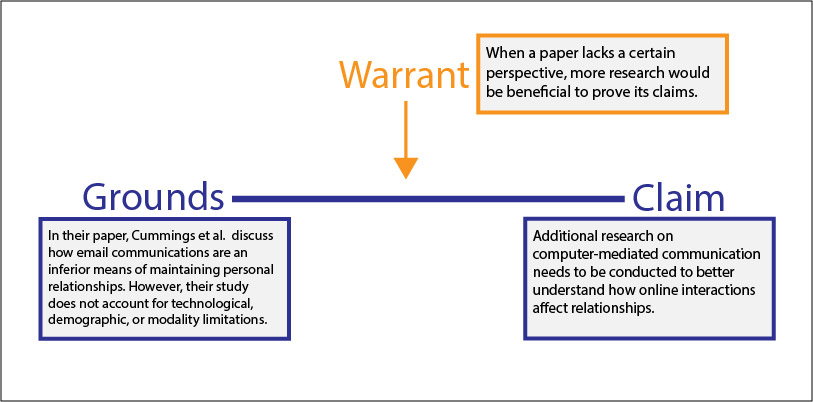
Toulmin Method's Six Component Parts: claim, grounds, warrant, qualifier, rebuttal, and backing

* Following information from Purdue OWL/Toulmin Argument page

In Toulmin’s method, every argument begins with three fundamental parts: the claim, the grounds, and the warrant. 

1. A claim is the assertion that authors would like to prove to their audience. 
It is, in other words, the main argument.
2. The grounds of an argument are the evidence and facts that help support the claim.
3. The warrant, which is either implied or stated explicitly, is the assumption/explanation 
that links the grounds to the claim.

This image shows a diagram of an academic Toulmin argument with the grounds and claim linked by a warrant (that when a paper lacks a broad enough perspective, more research would be beneficial to prove its claims).


The next 3 components are not necessary for a Toulmin argument, but can be added when necessary: 

4. Backing refers to any additional support of the warrant. In many cases, the warrant is implied, and therefore the backing provides support for the warrant by giving a specific example that justifies the warrant.

5. The qualifier shows that a claim may not be true in all circumstances. Words like “presumably,” “some,” and “many” help your audience understand that you know there are instances where your claim may not be correct. 

6. The rebuttal is an acknowledgement of another valid view of the situation. (Counterclaim)

Including a qualifier or a rebuttal in an argument helps build your ethos, or credibility. When you acknowledge that your view isn’t always true or when you provide multiple views of a situation, you build an image of a careful, unbiased thinker, rather than of someone blindly pushing for a single interpretation of the situation


HOMEWORK for Thursday/Friday:
1. Watch the review video on Toulmin. Add to your notes. Go slowly through the samples where it demonstrates the application of these techniques. Toulmin Argument Video. (Also found in Schoology folder) 

2. In Schoology, complete the Toulmin Argument Annotation assignment. Found in this week's Schoology folder. 

3. Noredink.com- Assignment (Identifying claims and reasoning). 
Due: Sunday, January 10th (11:59 pm)